
Summary
- I assume digital welfare per FLOP is equal to the welfare per FLOP of a fully healthy human of 3.17*10^-23 QALY/FLOP. I guess this overestimates digital welfare.
- For the highest price-performance on 9 November 2023 of 4.2*10^18 FLOP/$, I get a cost-effectiveness of increasing digital welfare of 1.33*10^-4 QALY/$. This is 0.0899 % of my estimate for funding the Centre for Exploratory Altruism Research’s (CEARCH’s) High Impact Philanthropy Fund (HIPF) accounting only for humans, and 1.89*10^-9 accounting for humans, and soil ants, termites, springtails, mites, and nematodes. HIPF decreases human mortality, this increases the consumption of food, this increases agricultural land, this decreases the number of soil animals, and this increases their welfare for my guess that they have negative lives.
- I calculate the price-performance has to surpass 2.23*10^27 FLOP/$ for increasing digital welfare to be more cost-effective than increasing the welfare of soil animals, which corresponds to doubling more than 29.0 times starting from the highest one on 9 November 2023. One would need 60.9 years for this to happen for Epoch AI’s doubling time of the FP32 price-performance of machine learning (ML) hardware from 2006 to 2023 of 2.1 years.
- I suspect the growth in price-performance will slow down, and that therefore it will take even longer than suggested above for increasing digital welfare to be more cost-effective than increasing the welfare of soil animals. So I expect the most cost-effective ways of increasing the welfare of soil animals will remain much more cost-effective than the most cost-effective ways of increasing digital welfare at least over the next few decades.
- I think increasing the welfare of soil animals would still remain much more cost-effective than increasing digital welfare for the foreseeable future if soil animals have positive instead of negative lives. In this case, I would support interventions increasing instead of decreasing soil-animal-years.
Introduction
Discussions about how much to prioritise increasing digital welfare often focus on the probability of digital consciousness or sentience, like Sebo and Long (2024), and Rethink Priorities’ (RP’s) Digital Consciousness Project. They sometimes also analyse its importance, tractability, and neglectedness (INT), like 80,000 Hours’ profile on digital minds. I ultimately would like to know how much digital welfare can be increased per $, which is supposedly covered by ITN. However, very unreliably, to the point I consider explicit cost-effectiveness analyses strictly better. In this post, I compare the cost-effectiveness in QALY/$ of increasing the welfare of soil animals and digital beings. Here are my calculations.
Cost-effectiveness of increasing the welfare of soil animals
I analyse the cost-effectiveness of increasing the welfare of soil animals via funding HIPF, which is the most cost-effective way of increasing welfare I am aware of. I estimate it increases the welfare of soil ants, termites, springtails, mites, and nematodes 101 k (= 70.6*10^3/0.701) times as much per $ as cage-free corporate campaigns increase the welfare of chickens. HIPF decreases human mortality, this increases the consumption of food, this increases agricultural land, this decreases the number of soil animals, and this increases their welfare for my guess that they have negative lives. I calculate HIPF decreases 5.07 billion soil-animal-years per $, 469 M (= 5.07*10^9/10.8) times my estimate of 10.8 chicken-years improved by cage-free corporate campaigns per $.
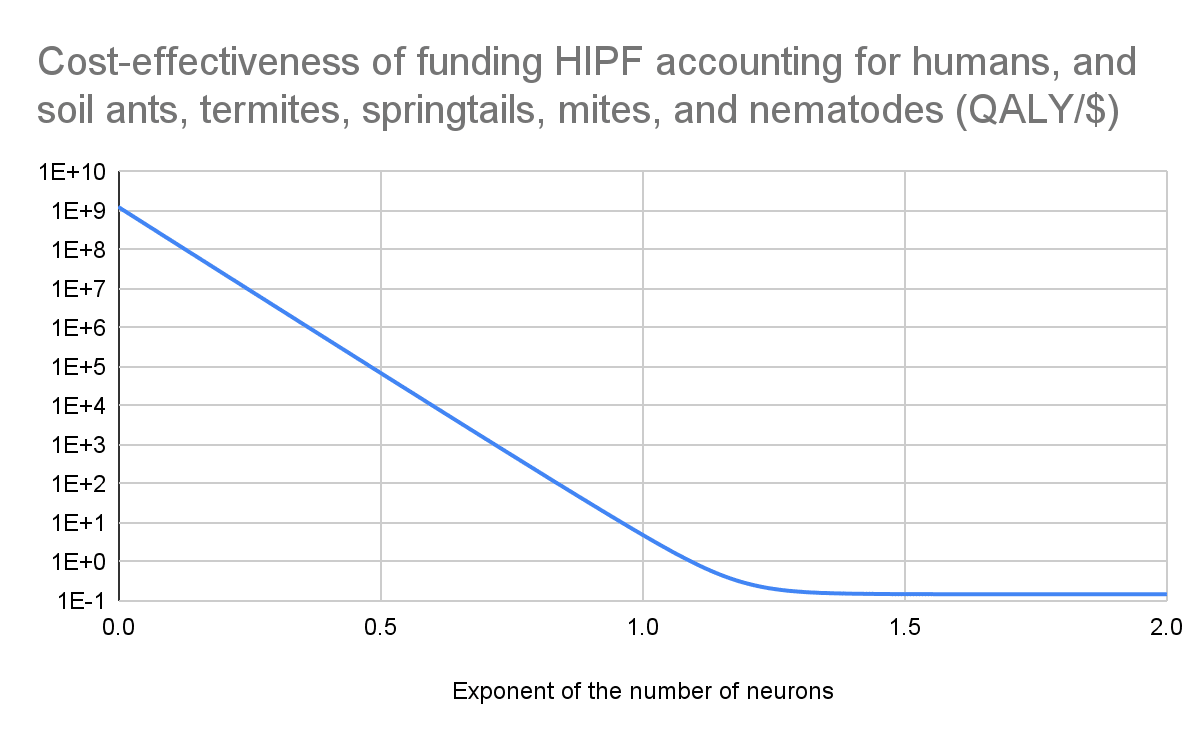
I use my past estimates for the cost-effectiveness of funding HIPF accounting for humans, and soil ants, termites, springtails, mites, and nematodes. There is lots of uncertainty about how much HIPF changes the welfare of soil animals. I supposed welfare per animal-year is proportional to the welfare range, the difference between the maximum and minimum welfare per unit time, and that this is a power law of the number of neurons. In particular, I used welfare ranges as a fraction of that of humans equal to “number of neurons as a fraction of that of humans”^“exponent of the number of neurons”, with the exponent ranging from 0 to 2. For an exponent of:
- 0, all animals have the welfare range of humans.
- 0.188:
- The welfare ranges are pretty similar to the estimates in Bob Fischer’s book about comparing animal welfare across species, which contains what Rethink Priorities (RP) stands behind now. An exponent of 0.188 explains 78.6 % of their variance.
- The number of neurons has to become 209 k (= 10^(1/0.188)) times as large for the welfare range to become 10 times as large.
- 0.5, corresponding to my best guesses for the welfare ranges, the number of neurons has to become 100 (= 10^(1/0.5)) times as large for the welfare range to become 10 times as large.
- 1, the welfare ranges are proportional to the number of neurons.
- 2, the number of neurons has to become 3.16 (= 10^(1/2)) times as large for the welfare range to become 10 times as large.
My results are below. Funding HIPF is super cost-effective for a low exponent which makes the welfare per soil-animal-year significantly negative. For a high exponent which makes it negligibly negative, the cost-effectiveness of HIPF converges to that accounting only for humans.
Cost-effectiveness of increasing digital welfare
I assume digital welfare per FLOP is equal to the welfare per FLOP of a fully healthy human. I guess this overestimates digital welfare.
Assuming a human brain has a computational power of 10^15 FLOP/s, it performs 3.16*10^22 FLOP per human-year. So the welfare of a fully healthy human is 3.17*10^-23 QALY/FLOP for a welfare of 1 QALY per human-year.
The hardware listed by Epoch AI on 9 November 2023 performing the most operations per $ had a price-performance of 4.2*10^18 FLOP/$. Multiplying this by the above welfare per FLOP, I get a cost-effectiveness of increasing digital welfare of 1.33*10^-4 QALY/$. This is 0.0899 % of my estimate for funding HIPF accounting only for humans, and 1.89*10^-9 accounting for humans, and soil ants, termites, springtails, mites, and nematodes for my preferred exponent of the number of neurons of 0.5.
I estimate funding HIPF increases the welfare of humans 59.8 times as cost-effectively as the personal welfare per $ of a fully healthy human just spending the minimum cost of a calorie sufficient diet. I determine this to be 0.00247 QALY/$ for a global cost in 2022 of 0.93 2021-$/human-day, which is 404 $/human-year.
Likewise, I guess one can increase digital welfare more cost-effectively than directly paying to run the hardware with the highest price-performance. However, I also think funding HIPF is very unlikely to be the most cost-effective way of increasing the welfare of soil animals. I believe this would optimise to increase the welfare of soil animals (instead of human welfare as targeted by HIPF), or decrease the uncertainty about the effects on soil animals, such as by investigating whether soil nematodes have positive or negative lives.
Comparison between the cost-effectiveness of increasing the welfare of soil animals and digital beings
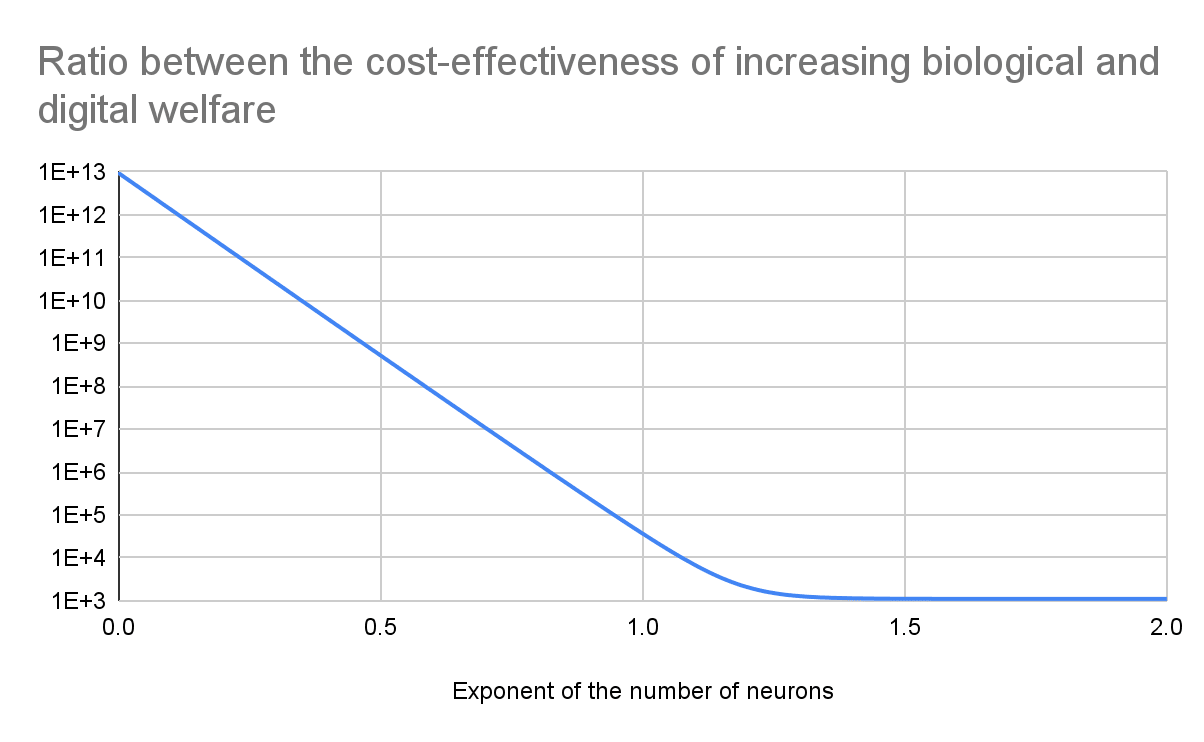
Below are some graphs comparing the cost-effectiveness of funding HIPF accounting for humans, and soil ants, termites, springtails, mites, and nematodes with that of increasing digital welfare running the hardware with the highest price-performance on 9 November 2023 if its digital welfare per FLOP is equal to the welfare of a fully healthy human per FLOP.
Increasing the welfare of soil animals is many orders of magnitude more cost-effective than increasing digital welfare for any exponent of the number of neurons. For my preferred exponent of 0.5, increasing the welfare of soil animals is 530 M times as cost-effective as increasing digital welfare.
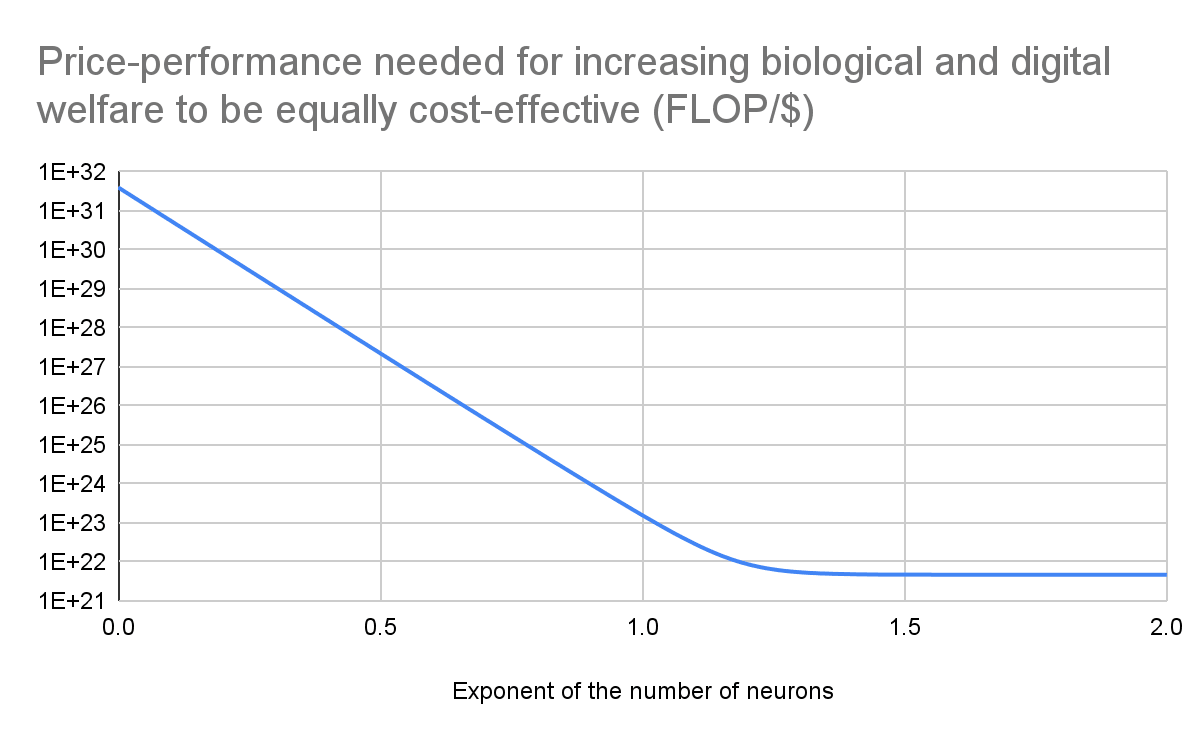
For my preferred exponent of 0.5, the price-performance has to surpass 2.23*10^27 FLOP/$ for increasing digital welfare to be more cost-effective than increasing the welfare of soil animals.
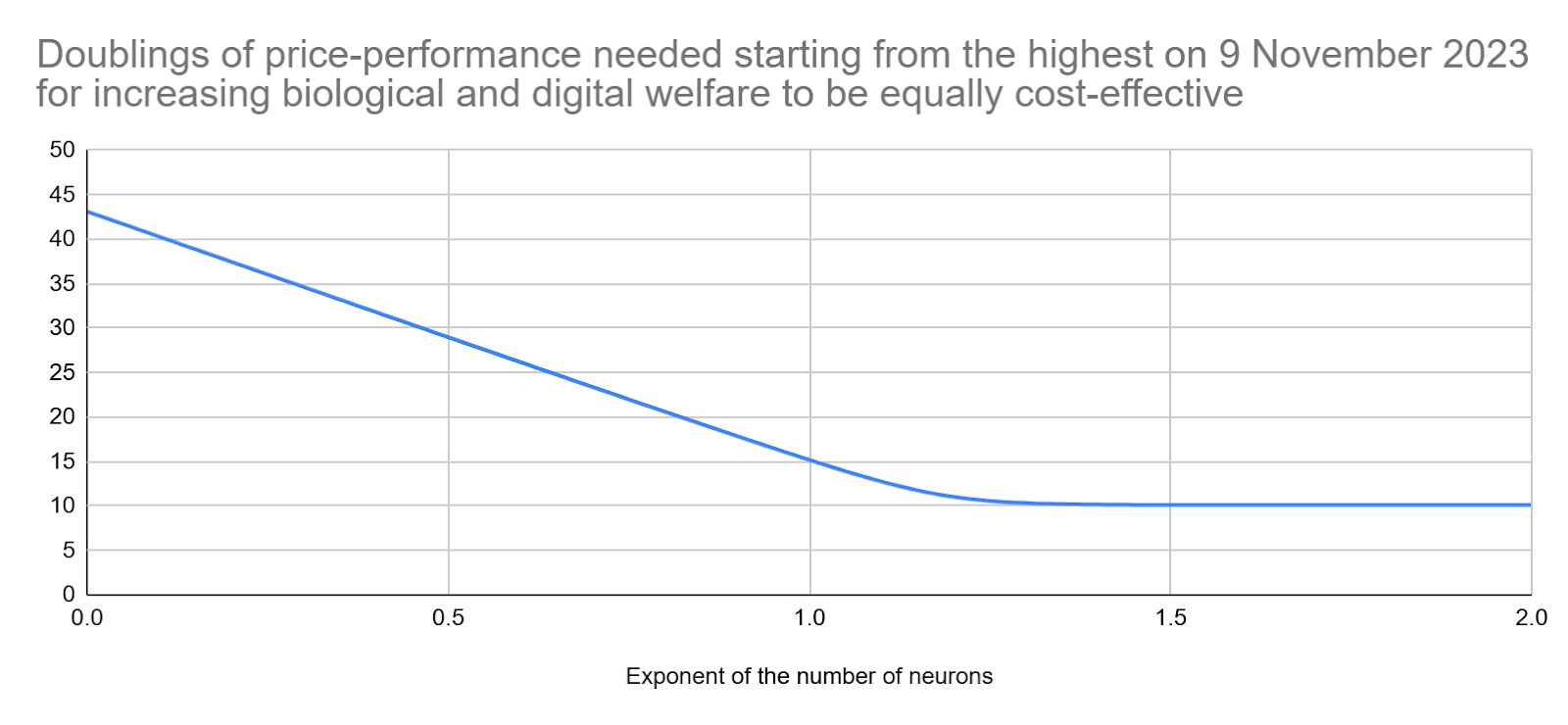
For my preferred exponent of 0.5, the price-performance has to double more than 29.0 times, starting from the highest on 9 November 2023, for increasing digital welfare to be more cost-effective than increasing the welfare of soil animals.
Below are the years from 9 November 2023 until reaching the price-performance needed for increasing the welfare of soil animals and digital beings to be equally cost-effective. I rely on Epoch AI’s doubling time of the FP32 price-performance of ML hardware from 2006 to 2023 of 2.1 years. For my preferred exponent of 0.5, one would need 60.9 years. So I expect the most cost-effective ways of increasing the welfare of soil animals will remain much more cost-effective than the most cost-effective ways of increasing digital welfare at least over the next few decades.
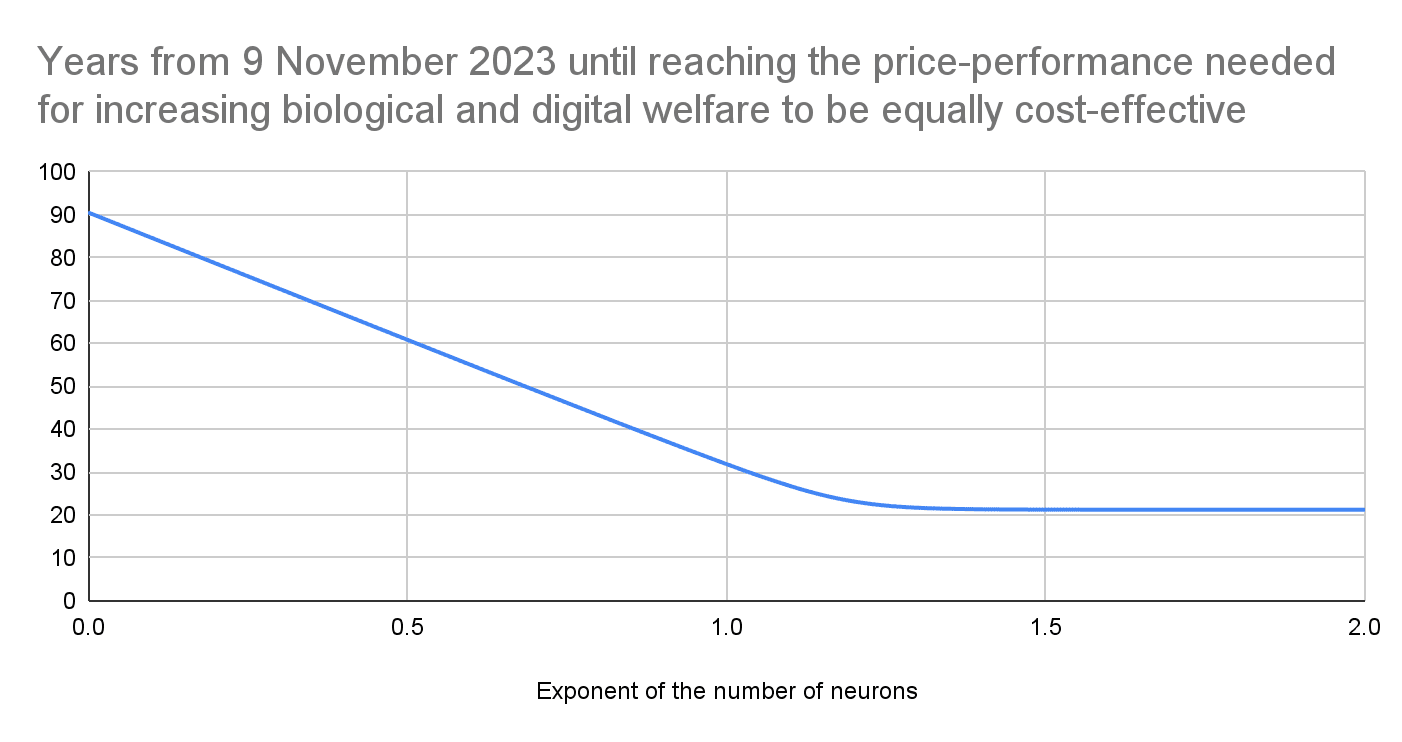
The doubling time I use is based on 17 years (= 2023 - 2006) of data, and all of the estimates above exceed this, thus not being reliable. Yet, I suspect the growth in price-performance will slow down, and that therefore it will take even longer than suggested above for increasing digital welfare to be more cost-effective than increasing the welfare of soil animals. Jaime Sevilla from Epoch AI expects nearterm price-performance to be proportional to the energy efficiency (FLOP/J) of complementary metal-oxide semiconductors (CMOS) microprocessors, and they estimate this can only become 50 to 1 k times as large before hitting physical limits, which amount to 5.64 (= LN(50)/LN(2)) to 9.97 (= LN(1*10^3)/LN(2)) doublings. These correspond to 11.8 (= 5.64*2.1) to 20.9 years (= 9.97*2.1) for the recent doubling time, which is significantly less time than my estimate of 60.9 years of similarly fast growth needed for increasing digital welfare to become more cost-effective than increasing the welfare of soil animals.
What if soil animals have positive instead of negative lives?
In this case, I would support interventions increasing instead of decreasing soil-animal-years. Nevertheless, I think increasing the welfare of soil animals would still remain much more cost-effective than increasing digital welfare for the foreseeable future. I concluded the cost-effectiveness of increasing the welfare of soil animals is approximately proportional to the increase in agricultural-land-years per $ for an exponent up to 1.12, and I do think the largest reductions in agricultural-land-years per $ are that different from the largest increases in agricultural-land-years per $. I estimated School Plates decreases agricultural land by 610 m2-year/$, and funding HIPF increases it by 1.29 k m2-year/$, which imply School Plates increasing the welfare of soil animals roughly -47.3 % (= -610/(1.29*10^3)) as cost-effectively as funding HIPF.
Acknowledgements
Thanks to Anson Ho, Jaime Sevilla, and Robi Rahman from Epoch AI for feedback on extrapolating the recent growth in price-performance. I listed their names alphabetically.
Thanks for sharing your analysis, Vasco. Two quick questions:
1. Could digital welfare capacity turn out to be much more efficient than in humans?
2. How would you think about interventions we could pursue now that might prevent large-scale digital suffering in the future, e.g., establishing norms or policies that reduce the risk of mistreated digital minds decades from now?
Thanks for the comment, Lucius!
I guess the welfare per FLOP of current AI systems is lower than human welfare per FLOP because humans are sentient, whereas AI systems may not be, but I do not know how to estimate digital welfare in any principled way. It would be great to have some research on estimating digital welfare in QALY/FLOP, which matters much more from the point of view of increasing welfare than the probability of consciousness or sentience that are often the focus of discussion.
For my preferred exponent of the number of neurons of 0.5, the price-performance has to double more than 29.0 times (becoming 530 M times as high), starting from the highest on 9 November 2023, for increasing digital welfare to be more cost-effective than increasing the welfare of soil animals. I think the world after so many doublings would be very different from the current one, which makes me pessimistic about our ability to influence it. It would be like trying to influence digital welfare today via interventions 60.9 years ago, which is my best guess for the time from 9 November 2023 until increasing digital welfare being as cost-effective as increasing the welfare of soil animals for price-performance doubling every 2.1 years.
I would look out for Rethink Priorities' digital consciousness model (and other work they are doing here) which should be coming out soon-ish. I don't think they would call it definitive in any sense, but it could be helpful here.
I think a major way this could be wrong is if you think we could get lots of digital minds in some amount of decades and early research/public engagement can have an oversized impact on shaping the conversation. This might make digital minds way more important, I think.
I'm also generally pretty interested in people doing more digital minds cross-cause prio (I'm working on a piece now)!
Thanks for the comment, Noah.
I am looking forward to the results of RP's Digital Consciousness Project, but I do not expect any significant updates to my views. It focusses on the probability of consciousness, but I think this says very little about the (expected hedonistic) welfare per unit time. This is because I believe there is much more uncertainty in the welfare per unit time conditional on consciousness than in the probability of consciousness.
I suspect the number of digital minds is not among the most relevant parameters to track. It may not be proportional to total digital welfare because more digital minds will tend to have less individual welfare per unit time. I would focus more on the digital welfare per FLOP, and FLOPs per year.
I am also interested in more comparisons between the promise of increasing biological and digital welfare. Nice to know you are working on a piece!
Many questions in this space rely on assumptions about whether insect lives are positive or negative, though I haven't seen much discussion of this explicitly (mostly just heard them in conversations). Is there not much that can be done to learn more other than what has already been done?
If so, the insect welfare initiatives that are interested in creating more or less are going to need to be dropped by 1-2 OOMs to account for massive uncertainty (say, 5% higher that they are positive), which is weird. It also wouldn't be very robust in that the probability we do something good vs bad is quite fragile (especially a problem for many non hedonistic utilitarian views).
Do you have further takes here, Vasco?
Thanks for the interesting points, Noah.
I said in the post "I analyse the cost-effectiveness of increasing the welfare of soil animals via funding HIPF, which is the most cost-effective way of increasing welfare I am aware of". This was for my best guess at the time that increasing agricultural land increases welfare due to decreasing the number of soil animals, and these having negative lives. However, I am now very uncertain not only about whether soil animals have positive or negative lives, but also about whether increasing agricultural land decreases or increases the number of soil animals. I recommend research informing how to increase the welfare of soil animals over pursuing whatever land use change interventions naively seem to achieve that the most cost-effectively. In addition, I would prioritise more research on comparing the hedonistic welfare of different potential beings (animals, microoranisms, and AIs).
I estimated the cost-effectiveness of HIPF assuming "the [expected hedonistic individual] welfare per animal-year of soil ants/termites/springtails/mites/nematodes is -25 % that of fully happy soil ants/termites/springtails/mites/nematodes". The expected cost-effectiveness only depends on the mean of the distribution of the individual welfare per animal-year as a fraction of that of fully happy animals. So one could have my best guess for the mean of this distribution while being arbitrarily uncertain. For example, a normal distribution with 5th and 95th percentiles of -5.25 (= -0.25 - 5) and 4.75 (= -0.25 + 5) would have a mean of -0.25 (my best guess), standard deviation of 11.1 (= 2*5/(0.95 - 0.05)), and probability of being negative of 50.9 % (= NORMDIST(0, -0.25, 11.1, 1)), which seems reasonable to me. A normal distribution with 5th and 95th percentiles of -50.25 (= -0.25 - 50) and 49.75 (= -0.25 + 50) would have the same mean of -0.25, standard deviation of 111 (= 2*50/(0.95 - 0.05)), and probability of being negative of 50.1 % (= NORMDIST(0, -0.25, 111, 1)). This is 9.00 (= (0.509 - 0.5)/(0.501 - 0.5)) times as close to 50 % as the probability of the 1st distribution being negative, but the expected cost-effectiveness would be the same for both distributions. What changes is that the cost-effectiveness of decreasing the uncertainty about whether soil animals have positive or negative lives is higher for the 2nd distribution.
For my assumed human performance of 10^15 FLOP/s, and human basal metabolic power of 80 W, the computational energy efficiency (operations per unit energy) of humans is 12.5 k GFLOP/J (= 10^15/80). This is 5.00 times (= 12.5*10^3/(2.5*10^3)) that of NVIDIA B100 (released on 15 November 2024), which is the ML hardware on Epoch AI's database with the highest computational energy efficiency. Epoch AI estimates the computational energy efficiency of ML hardware has increased 30 % per year, as is illustrated below. At this rate, ML hardware will reach the computational energy efficiency of humans in 6.13 years (= LN(5.00)/LN(1 + 0.3)). As a result, digital welfare per unit energy consumption will soon be similar to human welfare per unit energy consumption if digital welfare per FLOP is similar to human welfare per FLOP.
Computational energy efficiency tends to increase with performance, as is illustrated by the data below collected by Epoch AI. I assume organisms with a smaller individual mass tend to have lower performance. So I think humans have a higher computational energy efficiency than animals, and that these have a higher one than microorganisms.