
Charlie_Guthmann
Bio
pre-doc at Data Innovation & AI Lab
previously worked in options HFT and tried building a social media startup
founder of Northwestern EA club
Posts 13
Comments297
Re meetup and groups: You need to find a balance of inclusivity. Even though the purpose of a group is largely to socialize, the medium in which socializing takes place should be attractive in some sense orthogonally to how cool a person is. e.g. I like to go play basketball. I also socialize with the people at basketball. sometimes the people there are weird, it's ok, i still like basketball and have a good time and come again. Vs. a group that's basically just to socialize, the cool people get less out of it if the other people aren't cool and so they leave and it spirals.
The reason I said "Developing online platforms that allow individuals to host in-person community events for free." was because Meetup currently costs $175 a year and is the main platform in my city
If people really wanted to meetup more, there are tons of possible ways it could happen cheaper, both through existing competitors (facebook events/groups, reddit, listservs, 222, RA, and way more, trust me). While sorting and selecting the best events is not extremely easy, it's not that hard. If you actually put a few hours asking around where events are posted and then 1-2 hours of effort scrolling through these things (local websites, instas) you can fill up your calendar with random stuff (although I will say I think a lot of young 20s people don't realize that you could just ask a few store owners and librarian where the events are and you will learn a lot). It's true we could drive the marginal cost down even further and this should help some but after thinking about this alot (and trying to get people to actually join things and or/post events) i'm not convinced this is the core of the problem. I think the core of the problem is more that we don't have enough supply of actually good events and communities + increasingly entertaining other options that become hard to break habits so we might need some light paternal guidance in the right direction. Operationalizing this into a solution ends up looking closer to a religion than an app.
I would also be interested in seeing what some researchers could come up with, and I def think there is a lot of innovation on the side of thirdspace design and group norms/ activity setups that can improve social life, but OTOH so much of what makes a group is its people and leaders, and that's not something that is easy to scale, repeating but scaling it seems more social movement/religion in nature than modern tech.
Hey James, very concerned with number 1 also. I actually spent a year building an events app (i gave up), it's a very tough space. For one it's not clear why people need more two sided market places (spontaneous event/hangouts apps are also considered one of the biggest "tarpits" for entrepreneurs, though i'd caution reading too deeply into that type of stuff). ATP partiful and lu.ma are solid enough in terms of e vites, for really small groups you use i message. then maybe you are gesturing more at meetup or pie but these apps suffer from weird sociological dynamics. You can not just get a bunch of lonely people together and have a good time exactly. The more you look into this stuff, the more it feels like an omni problem. It's hard to say the tractability. There is a huge design space of things to improve on, you gesture at this. The problem spans addiction, habits, thirdspaces, culture, trust, etc. I don't know if that's a good or a bad thing in terms of being able to make headway.
I do believe ai might have some promise in terms of creating better events wikis (e.g. https://cguth7.github.io/events/ ).
Feel free to reach out whenever, I have much more to say on the topic.
Very cool.
I work on text parsing / meta science and do a lot of stuff like this on the side and for my lab.
https://docgmedicalsummaries.com/rankings
I've done something similar for ranking clinical medicine articles, it's pretty similar to your site but might be able to share some insights. (might comment more later regardless, just throwing this up for now so I remember).
edit: also signing up will auto subscribe you to emails just to note but should be easy to unsubscribe, can also see how we do rankings without signing up on the landing page.
YESSSSS didn't think I would get to see some hoops on the forum, thanks.
But I would be remiss to not give credit to 2 other dudes who should get some love from EA, Morey and Harden! To be fair trying to assign exact credit for who spurred the 3 pt revolution is hard and I don't claim to be confident, and also it is definitely true that curry helped accelerate the revolution, though I would probably put the curry warriors as the 2nd or 3rd most important group in doing so.
I think the Morey/Harden/rockets (and possibly seven seconds suns but will ignore for now) probably deserve more credit, although definitely curry/warriors if you mean who made the public think 3>2. (and I'm not claiming that the point of your post was to give curry all or the most credit, I just can't help myself in filling in some more basketball history for those interested).
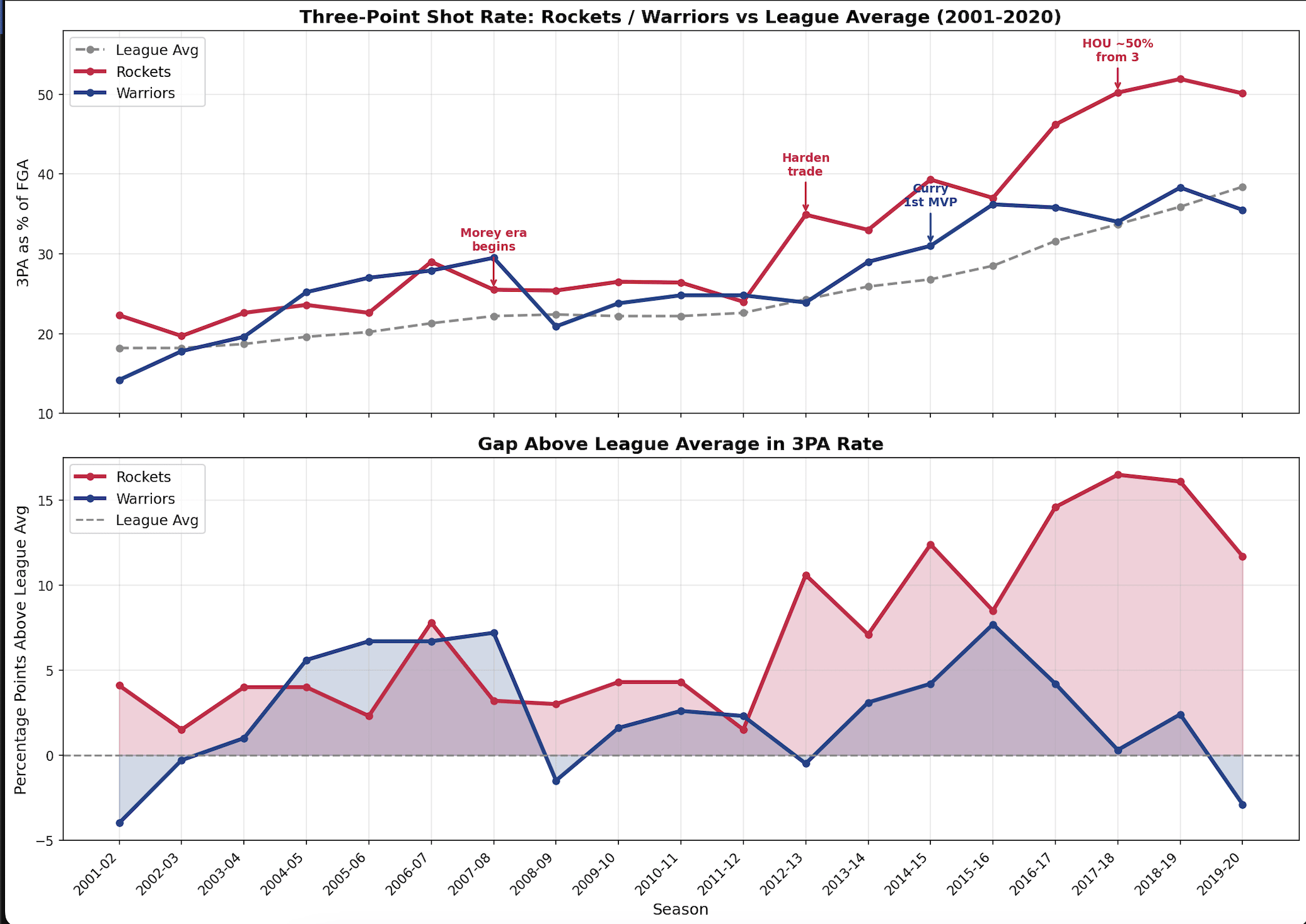
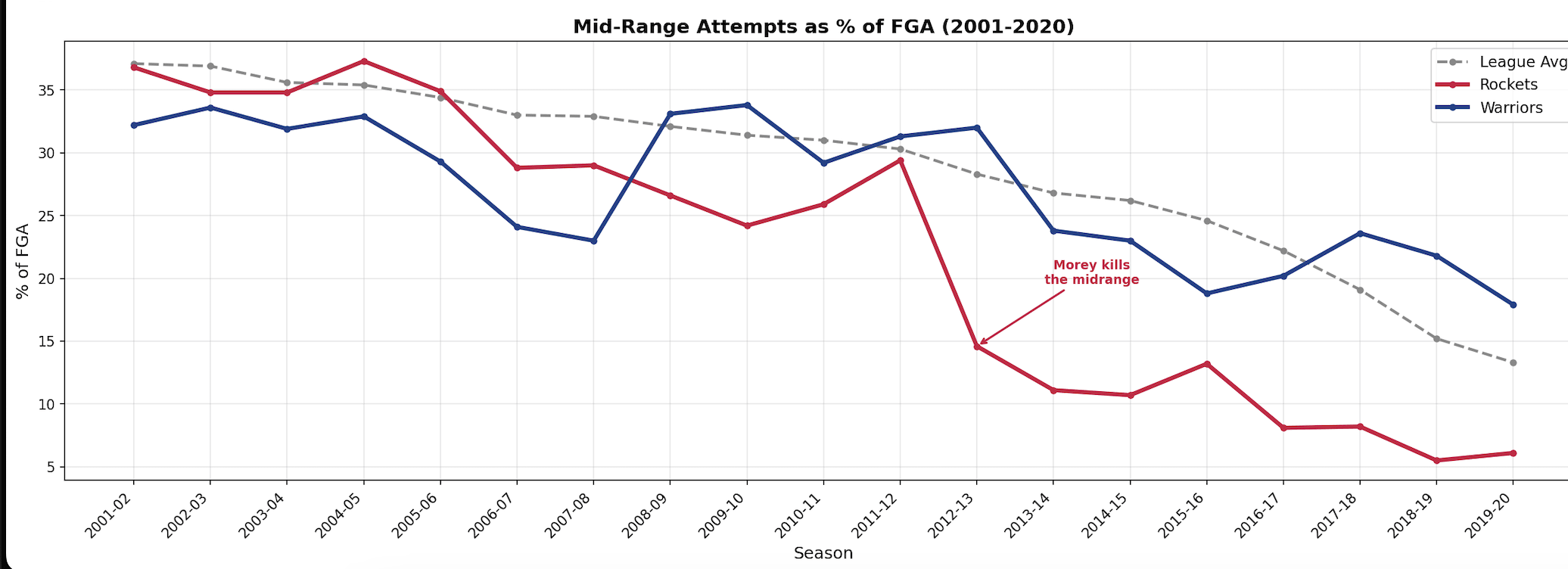
The thing about curry is he is the greatest to ever shoot it. You simply can't acquire a curry. Also, my read of Steve Kerr is that he is honestly not that analytic pilled as a coach. Like he is certainly on the more forward thinking side but he's not a math demon the way Morey was. He did have them running an incredible offensive scheme though don't get me wrong, but it was highly artistic and free flowing.
Morey was kinda the one to realize that you really shouldn't take midrange at all. This was the first domino in the revolution (although looking at the midrange chart above, seems like league had been slowly realizing that before him). You should never ever ever take a step in, which players often did. In fact, you should often take a step back even if you are open from the midrange (although the step back didn't explode in popularity till later). And you should put your role players on the three point line in the corners/wings, not in the midrange (and similarly, you should acquire players who can hit those shotes).
I also think while on first glance, it's easy to think of the 3 pt revolution as completely analogous to something like the shift in baseball - basically pure math that would have been true at any point in the league - I think it's probably at least a little less of a brain fart (though still mostly a brain fart) than it might initially seem. I think there was actually a series of (relatively simple) innovations that had to occur.
Just because league 3pt TS% > 2 pt TS% (in the halfcourt), this doesn't mean that the marginal 3 pt is higher EV / TS than the marginal 2 pt. Now I happen to think that it still probably was (i.e. like a good shooter jacking up some contested 3 still better than replacement 2 from that team), but you have to figure out exactly how to generate those extra 3s. At first I think it's obvious, just replace the middies with the threes. But then you have done picked all of this fruit, and now you have to figure out some more complicated ways to generate more.
Some (haters like myself) might argue this is where the warriors really came into play. The warriors abused moving screens harder than had ever been done in the history of the league, and in doing so, they were able to generate a few more clean looks a game. This definitely was very influential and you can see the proliferation today, with almost every screen set in the nba today being technically illegal (I hate to call this an innovation but...).
After everyone started abusing the moving screens, we needed even more innovations to generate new threes. Again I think here Harden and Morey shine, with the step back 3 revolution occuring around 2017-2018 by Harden.
Anyway I'm super pedantic and I don't think this changes the implications of your post at all, just excited to write about basketball on the forum and wanted to add my 2 cents.
giving up ~0.00000000000000000000000000000000000001% of the lightcone is easily worth it on moral uncertainty grounds.
Agreed this seems prudent and plausible, but not so much so that I would feel confident that this would be the result of CEV ish stuff. Despite some of the technical hurdles mentioned involved with trying to meaningfully specify up front/value locking that we get to keep this solar system for us and the animals I feel like I could be convinced this is still the more likely path to end up in a good future for us (but not all sentient life throughout the lightcone).
But also, if the CEV of human values involves killing all humans, then doesn't that kinda mean killing all humans is the correct thing to do?
yea but the correct thing (from a human CEV) to do isn't equivalent to what is good for humans (and animals). I might be getting into button pushing semantics here.
I'm not sure why you think baking CEV into AI will result in a good future for animals (or humans), though if we are talking about "all sentient beings", I guess I would say probably. It seems quite likely to me that if there is a "CEV attractor state" or similar, it involves killing us all - I don't say this because I don't love animals or humanity. I just don't see how it could be remotely possible that we (earth evolved humans and animals) are efficient utility producers (by a wide range of definitions of "utility"). That being said, if CEV or similar is a real coherent concept, it almost certainly would prevent permanent torture/s-risks which would be nice.
but CEV is a fuzzy concept to me so might be misunderstanding (i've read the lw page and some other basic stuff and have a basic sense of stance deference and cosmopolitanism) .
Well I'd guess first i'd just say I only ever thought much about this stuff in the context of Chicago, and even then just in my little slice of the world. I'm sure different places have different textures.
Your second paragraph doesn't make that much sense to me. Do you think if meetup was free there would be way more events in your town? Seems unlikely to me. Don't get me wrong, network effects are totally in play in these markets and can create natural monopolies which reduce supply (and then market quantity) from social optimum, but i think that if it was 0$ instead of 175 you might have like 10-30% more groups. But it seems to me supply could reasonably 5x if we had a healthy society.
"I also think you're overemphasizing the need for group culture and leaders to be designed well, since I think this stuff just naturally arises in environments where typical people with shared interests come together." Hmm yea my mind could be changed pretty easily, I'd just like to see the studies (or maybe there already are similar things done in psyche or soc, i haven't looked much).