
Many moral views and social projects present themselves as inherently positive and constructive. They aim to add something to the world, to create, to build. Classical utilitarians seek to increase happiness and bring about a surplus of joy over misery. Communists aspire to realize a classless society. Kantians, perhaps, aim to bring about the Kingdom of Ends, a world governed by mutual respect and rational duty. Each of these visions looks outward and forward—toward what might be created.
By contrast, suffering-focused ethics (SFE) begins with subtraction. Not in the sense of gloom or pessimism, but in its focus on removing rather than adding. Reducing pain, preventing cruelty, alleviating distress. Many suffering-focused ethicists do value positive goods and want them promoted. However, because they focus on suffering, they will spend most of their energy on reducing disvalue rather than promoting value.
There is nothing intrinsically wrong with this orientation, but it can cast SFE in an unflattering light. Building up is associated with life, civilization, and abundance. All of these have positive connotations. Subtraction, by contrast, has a negative connotation; it evokes austerity, decay, even nihilism.
A Drive to Create
When we think of a project, an achievement, a work of art, we generally imagine an addition to the world—a new creation that wasn’t there before. We want our actions to leave a visible trace, a sign that we contributed something lasting. If, as Nietzsche suggested, life is to be lived as a work of art, then each of us wants to wield a brush, not an eraser. We dream of making our mark, some tangible good—a building, a family, a philosophy, a legacy—that the world now possesses because we were here.
This bias toward addition likely runs deep in our evolutionary and social history. Contributing to the group’s resources improved its chances of survival and was thus rewarded—both genetically and socially. Subtracting from its resources, by contrast, generally harmed the group and so was punished. Even today, we can still hear echoes of that ancestral suspicion toward subtraction when we ask, “What did they contribute? What did they bring to the table?” or when we urge, “Instead of tearing down, why don’t you build up?” We seem to tie moral worth to actions and people who add to the world in some visible way, rather than subtract from it.
This bias can make SFE look unattractive. Reducing suffering may seem important, yet without the addition of positive goods, the project can feel woefully incomplete. Consider the language people might use to disparage it: the aims of SFE are barren, hollow, empty, destructive. Such pejoratives conflate lack with loss, absence with deprivation, subtraction with harm. The double meaning of negative—as both “minus” and “bad”—captures this phenomenon perfectly.
Even to those otherwise sympathetic to SFE, its orientation toward subtraction can be demotivating. In our work, we want something to point to—some visible marker of progress, a sign that our efforts have left the world tangibly improved. But the absence of suffering resists display; it leaves no monuments. And in a world still filled with immense pain, progress can feel hopeless, drowned out by what remains.
Overcoming these instincts is difficult, as with any deep bias. Yet one promising approach is to reframe SFE in positive, constructive terms. This reframing does not alter its core; it merely reshapes its image. By portraying the reduction of suffering as a form of building, we speak to our innate sense of purpose, our longing to add something of value to the world. In doing so, the ethic can channel the same creative and social energies that animate most human striving.
A Constructive Reframing
Particular projects within SFE can easily be cast in positive terms. The task is not merely to subtract suffering in the abstract, but to construct the conditions for compassion, stability, and safety. We build institutions that prevent cruelty—democratic and just governments, well-equipped hospitals, and peaceful communities of care. We build moral cultures of impartial concern and empathy. And we build ourselves into wise and compassionate moral agents who act with composure to improve the world.
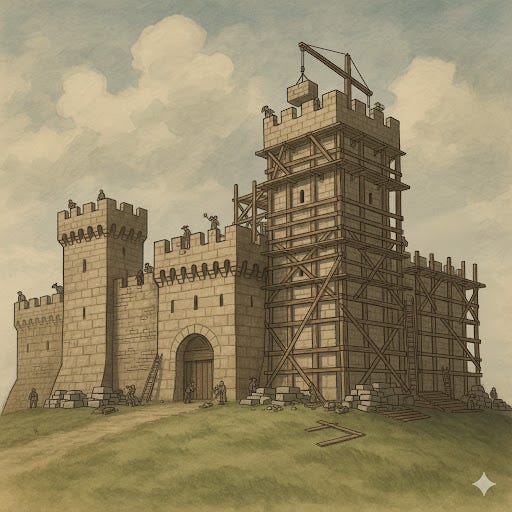
Perhaps it helps to imagine a single, unifying if metaphorical goal: we are building a fortress to shield all sentient beings from suffering. Every vaccine, every peacekeeping treaty, every act of compassion is a stone in its foundation. The task is to build it strong—with deep foundations and enduring walls—so that it can protect for the long haul. Its strength must withstand storms from every direction, both natural and human-made, from sudden catastrophes to slow, imperceptible erosion.
The fortress metaphor carries deeper lessons. It reminds us that reducing suffering is often steady, painstaking work. It cannot be accomplished in a day, nor completed while the world still harbors tremendous pain, or even risks of tremendous pain. The fortress must be tended continually—its foundations reinforced, its breaches repaired, its walls adapted to new threats.
It reminds us that civilization itself is often one of our greatest defenses against suffering. Stability and endurance protect us from chaos, violence, and despair. They grant us the time and security to reflect, to study, and to act methodically rather than impulsively—to reduce suffering with wisdom rather than ill-considered haste.
It reminds us to embrace prudence and inherited wisdom: radical solutions are risky, and silver bullets are unlikely, so favor tried and true methods when possible, as old as fortress walls. Build the fundamentals of cooperation, resilience, and care for others that have served us well in the fight against suffering.
The fortress metaphor reminds us to be clear-eyed about our limits as well as our power, and stay focused on what lies within our control. This is no elaborate tower to the heavens; it is elegantly simple and practical, signifying a deeply grounded humility.
It also reminds us that in the fight against suffering, we are all linked. Across cultures, languages, and moral traditions, the fortress we are building against suffering offers a shared purpose. Built on common moral ground, the project extends goodwill outward, protecting all of us against the worst. Though our values and motivations may diverge in many respects, we can all join this project, laying stones in cooperation.
With the fortress metaphor, the project of reducing suffering remains the same, but we can appreciate it in a new light. We are not merely erasing pain; we are constructing the walls that shelter us all from it. Within those walls lies the promise of a gentler future.
It would not be wrong to assert that the entire process of civilization consists of controlling innate human aggression and, therefore, that all moral efforts to ultimately improve society have a subtractive structure: do not aggress, do not harm, do not tolerate suffering.
Compassionate religious philosophies have thus attempted to develop "positive" abstract concepts capable of emotionally engaging the believer in an ideology of altruism and benevolence. The best known in the West are those of Christianity, such as "Love" ("Agape"), "Charity," "Holy Spirit," "Grace"... These terms undergo a process of symbolization, can be psychologically internalized, and act as motivating and guiding forces. Traditionally, they have been associated with the "numinous" or supernatural.
For those interested today in an effective reformulation of altruism as an ideology, it would be very useful to analyze these past strategies and adapt them to our current knowledge and experience of human behavior and its potential for social improvement.