
In London, where I live, it’s impossible to have a night out without a homeless person asking for cash. I think about these requests as a philanthropic investor.
A man sitting in front of a 24/7 grocery store begs me: “Hey man, my leg really hurts, my only joy in life is alcohol, could you please buy me a beer?”. He shows me his leg, and it looks… it looks really bad, like some kind of gangrene. I’m about to buy him a can of cheap lager, but first — to make it seem more like a gift from me — I decline his request. I hear his “please, please” as I walk in.
I’m making a split-second call: the alcohol might be load-bearing for this person’s psyche. Ten years ago I went through a few months of daily drinking, so let me tell you: sometimes alcohol is a problem, but not getting alcohol is an even bigger one. If he has a full-blown dependence, withdrawal might be coming — and unlike heroin withdrawal, alcohol withdrawal can kill.
You might be wondering why I didn’t call an ambulance — I am also wondering that now. It’d be better a better decision — that and buying him a beer.
Moral ambiguity
For a small-scale philanthropic investor like me, the moral ambiguity of decision-making under uncertainty and time pressure is an issue. If I give every homeless person what they want, I’d quickly go bankrupt. If I ignore every request, I miss the opportunity to impact lives of those in need. My default is to give money to people where it can lift them up from out of their local minima — a rough patch. I am not interested in funding the median case of a “professional beggar” — so I look for rare outlier cases. Even in those cases a person in front of me could be a scammer or my money wouldn’t help.
Elevator Pitch
Like other investors, I love an elevator pitch — a brief thirty-seconds way of introducing yourself and getting across your point. Homeless people are really good at this. They may or may not know the term, but negative reactions of people around them (people walking away) would sculpt their initial spiel into an elevator pitch.
I am glad these happen on the streets and not in actual elevators.
Two Outliers and a Typical Case
Autistic Man
Sometimes it’s an easy straightforward decision based on their pitch. A 25 year old man asks me: “Hey man, I am autistic and I came to a mental health hospital over there. I forgot my card and my phone is dead. Could you please buy me a bus ticket?”. This man isn’t even homeless. He doesn’t sound rehearsed — he sounds uncomfortable. I gave him a few pounds for the bus.
Charismatic Man
Sometimes a decision is less straightforward, but still clear enough. “Hey man, this is humiliating to ask, but I lost my flat 26 days ago. I am bipolar — I was diagnosed earlier this year, and I’ve bouncing like a yo-yo. I used to work as a cleaner, and I am trying to get on my feet, but I need 17 pounds to get a room today”.
He wears cheap but clean clothes, he sounds smooth and sincere. I ask a few follow-up questions, but the story he presents is coherent. So I give them the money.
I am taking on the risk that this man is scamming me — maybe even 50/50. But in my mind the probability of helping a person in need outweighs that risk. Smooth stories like these happen rarely — once every few months. I always feel that if they were a scammer with that level of charm and social skills, they could be scamming people more efficiently, for example by getting a sales job.
Typical case
The typical elevator pitch is fast with no back story: “Hey man, I am looking to raise 17 pounds for a room tonight in a shelter. Do you happen to have some change to spare?”. The verb “to raise” is used frequently — perhaps indicating the mindset of a temporarily embarrassed startup founder. It’s always the same non-round number — I guess the cost of the cheapest room on the market. I don’t know why, but this non-roundness creates credibility for me.
Still, in a few cases where I offer them to pay for a room with my card instead of giving them cash, they decline. There are excuses and shady explanations that don’t add up. Like maybe it’s 30 minutes away (I can walk with them) or they worry there might not be a room (I offer to give them cash in that case).
The typical case gets a pass — they don’t need help, they need money. They are professional beggars who will likely spend it on drugs and alcohol. I don’t have any problems with spending money on drugs and alcohol, but I’d rather spend money on drugs and alcohol for myself.
Dope
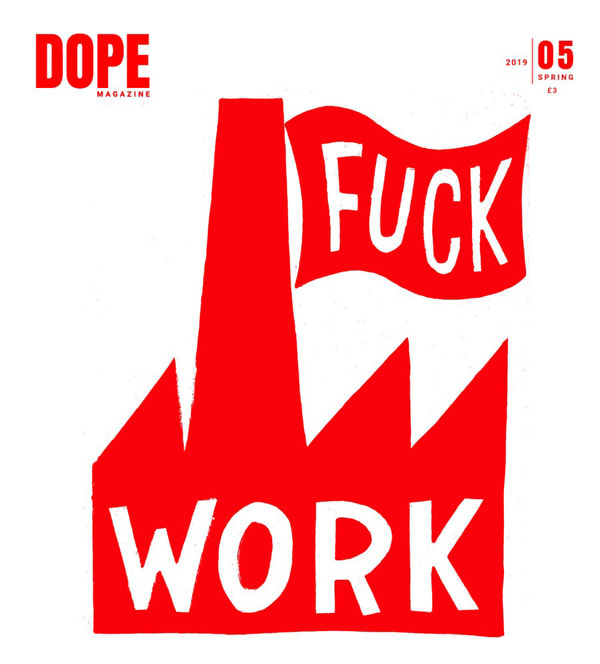
Still, I like some professional beggars. In East London homeless people sell a magazine called Dope. It’s a left anarchist magazine with cool covers. The cost is usually five pounds, and if you don’t have cash, they’ll take a card payment. Welcome to Cyberpunk East London — “high tech, low life” means that even homeless people are going cashless, metaphorically and literally.
I am more inclined to hand over money if I get a magazine back. Maybe that thin veneer of reciprocity just hacks the social machinery in my head. But, at least the covers are cool, so it’s a cool hack.

On being an effective ineffective altruist
Effective Altruism (EA) is a movement advocating for giving money to the most effective charities — delivering the most impact per dollar spent (for example, saving the most lives).
Their elevator pitch thought experiment is the following. You encounter a child drowning in a pond but are on your way to something important. But by getting in the pond, you’d have to experience an inconvenience such as wetting your suit. Do you save the child? If you would ruin a suit, you are doing moral calculus, you are obligated to donate some amount of money to effective charities to save children elsewhere.
As for me, I wouldn’t save the child — I can’t swim. That’s why I am not an effective altruist.
In Eastern Europe some beggars drug children to make them sleep beside them for extra sympathy — so they appear in a greater need for help. Occasionally they also use realistic dolls instead of babies for these purposes. So my question to you: are you even sure the child in the thought experiment is real?
I know, I know. It’s a thought experiment.
I’m not EA, but I am pretty EA-brained. The logic in this essay is influenced by EA. I am sympathetic to the movement in the part where they do a lot of good practical work, but many of their theoretical arguments are psyops designed to memetically colonise the brains.
Let me pick a different thought experiment to illustrate my point.
People online love Trolley Problems: would you pull a lever to save five people and kill one? No moral problems in life are shaped like Trolley Problems, and a lot are shaped like Giving Money to Homeless People. Having practiced the latter a lot, if I encountered the former, I’d be well-prepared:
“There are five people tied on the left track, and one on the right. The trolley is rushing toward the right. Do you pull the lever to divert?”
“Nice elevator pitch mate. But who the fuck are you and why are you tying people to the tracks?”
The moral reasoning is always a messy fractal irreducible to decontextualised thought experiments with yes/no answers. Remember who set up your thought experiment and for what purpose.